
Haib Cu Project
History
Small-scale mining (from late 1800s)
The Haib copper deposit is well exposed, with visible secondary copper minerals such as malachite and chrysocolla along fractures and river cuts – especially in the Volstruis (Ostrich) River that runs through the centre of the deposit. German prospectors were the first Europeans to recognise the mineralisation, carrying out small-scale mining between the late 1800s and early 1900s. Local prospector George Swanson played a long, intermittent role on the project from the post-WWII period into the early 2000s. Over the decades, he completed small-scale mining, operated leaching pads, and shipped hand-sorted high-grade copper to the O’okiep Copper Company in South Africa, 150 km to the south.
Early exploration (1960s–1970s)
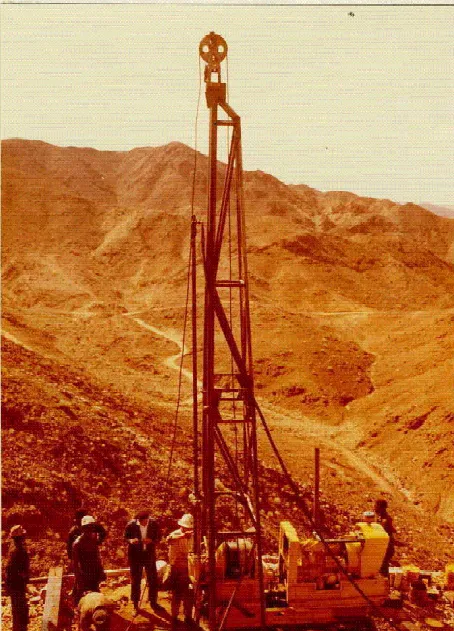
Falconbridge (1963–1964) completed the first significant modern exploration program, including mapping, stream-sediment sampling, ground geophysics, and 11 diamond drillholes (1,012 m).
King Resources (1968–1969) followed with the first Induced Polarisation (IP) survey and drilled 21 diamond holes (3,485 m), broadening the early understanding of the system.
Rio Tinto Zinc (RTZ) optioned the project in late 1971 and completed a major, systematic work program from 1972–1975.
Their work included:
- extensive regional and detailed mapping
- a large IP/Resistivity program
- metallurgical testwork
- 120 diamond drillholes (~45,900 m)
- drilling on a 150 m x 150 m grid using vertical holes
RTZ also assessed regional potential, including the Lorelei porphyry occurrence 120 km to the northwest. Their work remains a cornerstone of Haib’s modern geological understanding.
1990s attempts at development
Through the early–mid 1990s, several South African groups evaluated Haib as a potential “world-class copper producer for the 1990s,” completing desktop studies and economic analyses.
In 1995, Great Fitzroy Mines (GFM), Rand Merchant Bank (RMB) and George Swanson formed the Namibian Copper Joint Venture (NCJV).
NCJV’s work included:
- 12 diamond drillholes (~5,445 m)
- 5 geotechnical holes
- excavation of a 126 m adit and crosscuts
- metallurgical, milling, and grinding studies
A feasibility study followed in 1998, but activities ceased in 1999 due to difficult market conditions.
Modern licensing & ownership (2004–2017)
In 2004, Deep South Mining Co. was awarded EPL 3140 (74,563 ha).
The licence transferred to Haib Minerals (Pty) Ltd in 2013 and remains valid today at 36,589 ha. Haib Minerals is Koryx Copper’s Namibian subsidiary.
In 2008, Teck entered a joint venture and operated the project while earning a 70% interest.
Koryx Copper (then Deep-South Resources) acquired Teck’s 70% in 2017 and Teck still remains a significant shareholder today.
Teck’s contributions – re-evaluating potential
Teck’s program was designed to reassess both regional prospectivity and increase grade and tonnage potential at Haib. Their work included:
- remote sensing studies
- regional geophysical interpretations
- ground geophysics (IP/Resistivity and AMT)
- stream-sediment and soil geochemistry
- detailed “Anaconda-style” mapping
- relogging and resampling RTZ drill core
- 32 diamond drillholes (10,508 m at Haib, 3,745 m on satellite targets)
- the first modern 3D geological model of the deposit
- drilling inclined holes at Haib
Teck’s work significantly modernised understanding of Haib’s geometry and scale.
Recent work & strategic pivot (2018–present)
After Teck’s withdrawal, Koryx (then DSR) completed multiple studies, including a PEA in 2018 and an update in 2021. These assessments relied heavily on bio-leaching technologies, which the team no longer views as suitable.
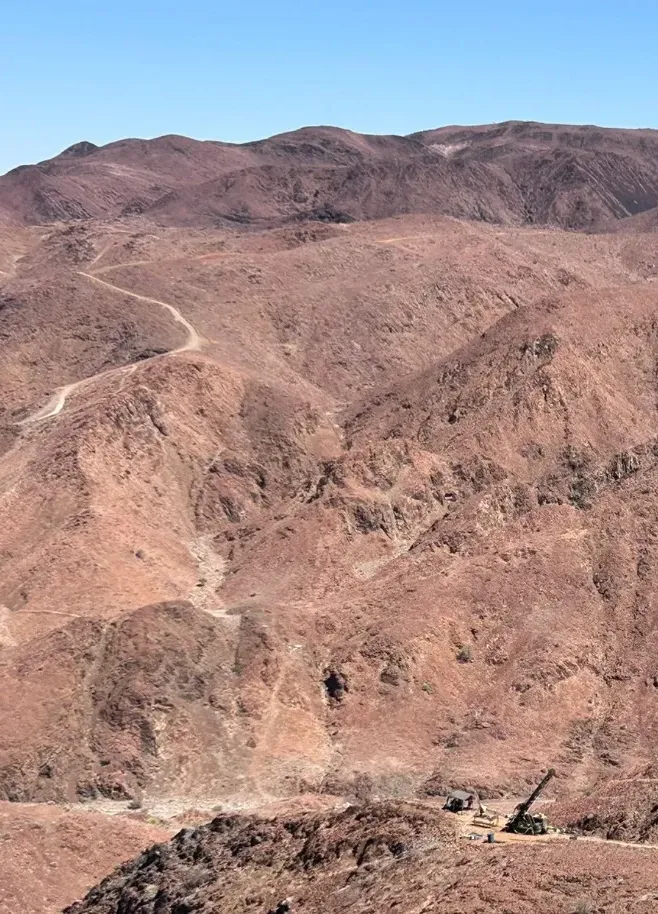
In 2021, drilling began to upgrade the mineral resource classification but paused due to a licensing dispute, which was resolved in July 2023. Drilling resumed later that year and finished in Q2 2024.
In September 2024, a new management and technical team took over, marking a decisive shift toward accelerating the project towards development – aligned with the strong fundamentals of Haib and the project’s long history of work.