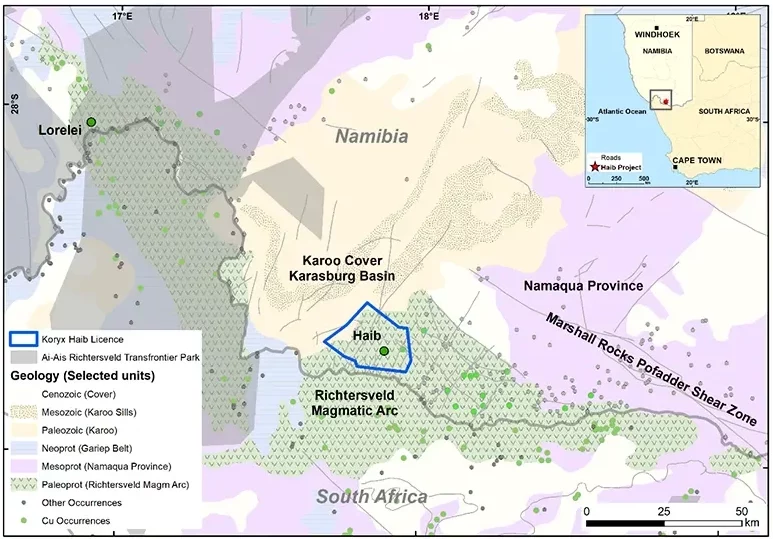
The Haib porphyry copper deposit lies within the Richtersveld Subprovince of the Namaqua–Natal Metamorphic Province. It forms part of the Palaeoproterozoic Richtersveld Magmatic Arc, a sequence made up of the Orange River Group (ORG) volcanic rocks (basaltic to rhyolitic) and the Vioolsdrif Intrusive Suite (VIS) plutonic rocks (mainly granites and granodiorites).
The host rocks at Haib have undergone up to four deformation events and regional metamorphism to greenschist facies. The area is also intruded by prominent, magnetic NE–SW trending Neoproterozoic dolerite–gabbro dykes.
Haib is one of only two known porphyry copper deposits in the Richtersveld Magmatic Arc, the other being the smaller Lorelei body located ~120 km to the northwest within the Ai-Ais National Park. At 1.9 Ga, Haib is one of the oldest porphyry copper deposits known, yet it retains the diagnostic characteristics typical of major porphyry systems despite its age and deformation history.
To the west, the Paleoproterozoic rocks are overlain by younger Karoo rocks of the Karasburg Rift Basin, consisting of basal tillite, limestones, siltstones, and shales. Cretaceous magnetic dolerite sills are common within the Karoo sequence.
Across the project, the ORG volcanics and VIS intrusives dominate the eastern half, while an unconformity marks the transition into Karoo sediments on the western half. The Haib volcanics consist primarily of Porphyritic (feldspar) Andesite (PA), with minor rhyolite in the north. The VIS intrusives form large granodiorite–granite batholiths cutting the Haib volcanic package.
Deposit geology
The dominant rock types at Haib are Porphyritic Granodiorite (PGD), Porphyritic (feldspar) Andesite (PA) and related hydrothermal breccias.
- The PGD intruded the PA at approximately 1.87 Ga.
- The PA is primarily linked to the ORG volcanics, although current interpretations suggest a partially intrusive origin.
The PGD (and related less voluminous felsic intrusives) and associated breccias form elongated bodies aligned with the Volstruis River valley, coinciding with many of the higher-grade copper intersections in the deposit.
Alteration across Haib is typical of porphyry copper systems:
- potassic alteration dominates the main mineralised zone
- surrounded by sericitic/phyllic and propylitic zones
- propylitic and sericitic alteration locally overprint earlier potassic phases
- silicification, sericitisation, chloritisation, and epidotisation are widespread
The main sulphides are pyrite and chalcopyrite, with minor molybdenite, bornite, and chalcocite. If a supergene enrichment zone ever existed, it has been largely eroded, and the system is considered deeply eroded.
Surface oxidation produces secondary copper minerals such as malachite, azurite, chrysocolla, and minor chalcocite, typically within fractures and joints. Oxidation rarely extends below ~30 m, and fresh sulphides are common at or very near surface. Although the oxide zone is volumetrically small, grades are often above average, suggesting potential for a small leachable oxide resource.
Both molybdenum and gold, although present in minor amounts, may represent meaningful by-product opportunities.
Target areas
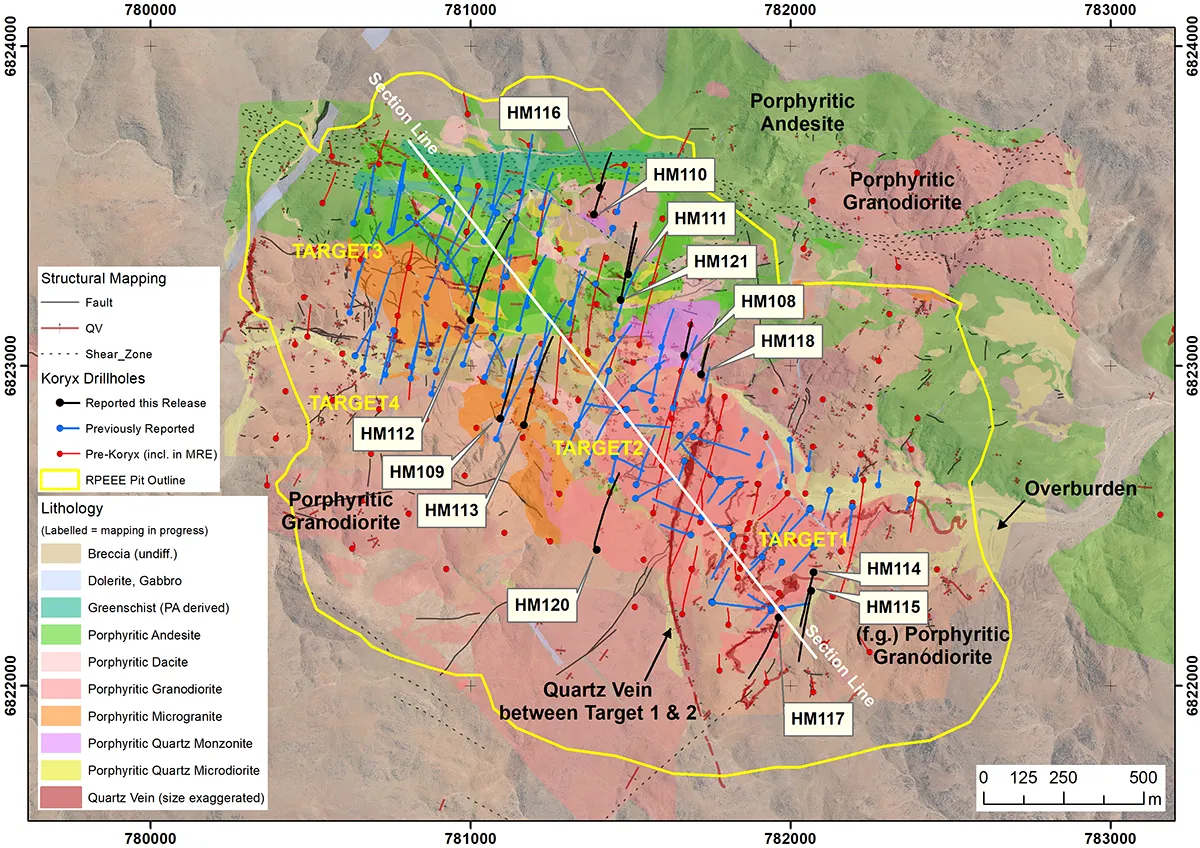
The Haib deposit is divided into four target areas, each defined by differences in host lithology, alteration, and mineralisation style.
Target 1
Located in the southeastern portion of Haib, Target 1 is bounded by the quartz vein in the west and potential faults to the south and east, and remains open to the north.
- dominated by potassic alteration
- copper mineralisation hosted mainly in PGD
- high-grade copper trends WNW–ESE, dipping 15–20° NE
- molybdenum is present but less developed than in other zones
Target 1 represents mineralisation from deeper within the original porphyry system.
Target 2
Target 2 lies centrally within a broad NW–SE-trending band of copper mineralisation dipping >80° southwest. It is bounded by the quartz vein to the southeast and PA hosting Target 3 to the northwest.
- stronger copper grades associated with hydrothermal breccias
- PA units also locally well mineralised
- upper portions show propylitic alteration, transitioning to potassic at depth
- molybdenum is well developed across most of Target 2, especially centrally and to the west
Target 3
Target 3 hosts some of the widest and highest-grade copper intersections at Haib. Mineralisation begins at or near surface and is linked to steeply dipping breccias within PA.
- mineralisation is cut off to the north by a large E–W striking, steeply dipping shear zone
- possible faulting limits mineralisation to the west
- propylitic alteration dominates
- molybdenum grades are low near surface but increase significantly with depth, with several broad, high-grade intersections
Target 4
Target 4 lies off the main NW–SE trend but appears to extend eastward to intersect Target 2.
- propylitic alteration dominates
- highest copper grades occur in steeply dipping breccias and PGD
- copper mineralisation trends E–W, dipping >80° south
- terminated to the north by a set of parallel E–W faults
- molybdenum is very well developed, with some of the best intersections in the project, comparable to the western parts of Target 2.